
Moral Exclusion
Plus, what's the Mandela Effect?

Issue No. 49
On a cobblestone street in the middle of an ancient city, a crowd is gathered around a performer. He’s a short figure, with make-up clumsily blotted around his eyes and lips, wearing a bright green costume that’s two sizes too big. He gestures for the crowd to move back a few steps.
Then he takes out a piece of white chalk from his pocket and draws a circle around himself on the ground. The crowd goes wild. Everyone in attendance understands that so long as the performer in the oversized costume and clown boots stays within that circle, he’s at liberty to belittle, ridicule, and say whatever he wants about anyone outside the circle, from the king on down. All for a good laugh of course.1
Everyone outside the circle is fair game.
I was intrigued by this image the first time I read about it. Not so much the idea of a circle that protects a performer, but the speed with which two groups of people can be categorized once a line is drawn between them. Where two jurisdictions with opposing taboos and power dynamics are immediately established.
There’s a concept called moral exclusion. It describes what happens when members of a group decide that their moral norms apply only to the group and not to anyone on the outside. Within the group, they’re upheld, but outside it, they’re seen as undeserved.
For instance, they’ll be just, but only with each other. They’ll be altruistic, but only with each other. They’ll be empathetic, but only with each other. The group creates a circle of care around itself.
Everyone outside the circle is fair game.
As with the street performer, it becomes acceptable for those on the outside to be demonized and, if need be, even harmed, without any of that creating moral dissonance within the group.
This is such a crucial concept because it’s at the heart of much of the divisiveness we see around us. Take any abhorrent effect like marginalization and you’ll find that you can often trace it back to some form of in-out-group thinking, some form of us-versus-them tribalism. Some form of moral exclusion.
We might be taken aback when we see dissonance as a behavioral trait in someone—how can someone who is otherwise rational hold such views about others? But when you study the person carefully, when you really dig deep, you might find that the person was forged in a crucible that conditioned them to see people as either inside a circle or outside it. The seed is often planted in our younger years.
Perhaps on the soccer field . . .
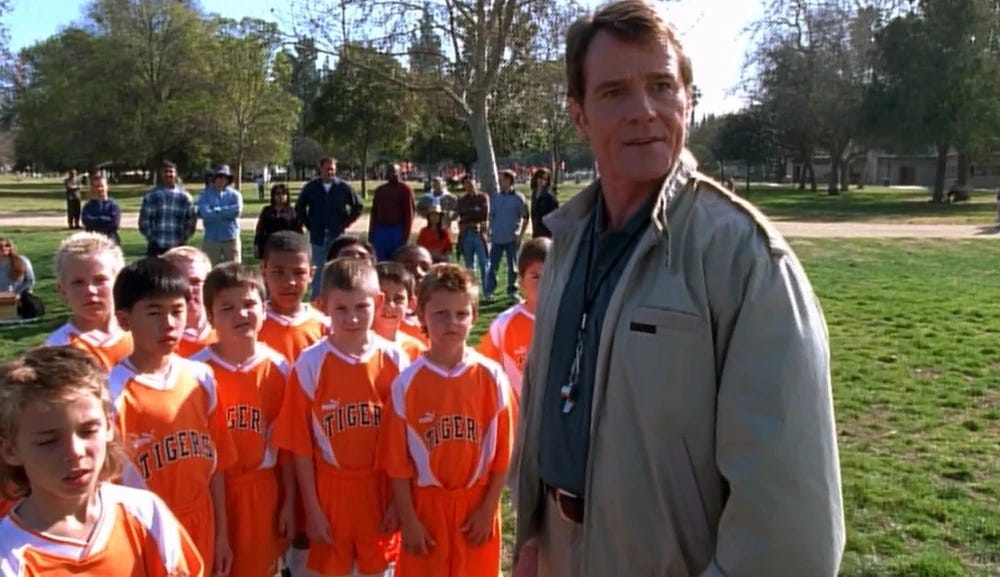
In an episode of Malcolm in the Middle, Hal (the dad who would go on to teach high school chemistry and make bank from drug selling) finds himself in the impossible position of having to motivate a kid’s soccer team. They lose that first match 48-0. Hal’s pep talks, emphasizing good sportsmanship and teamwork clearly aren’t working.
Lost for ideas, he asks them during the following week’s practice if they can think of another team that works well together. A little boy says, “The X-Men … because they fight evil.” A lightbulb goes off in Hal’s head and he improvises a speech in which he lets the boys in on a secret.
Youth Soccer has been infiltrated by the forces of evil. They have taken over every single team and are hellbent on total world domination. Only one team is left representing all that’s good and all that’s virtuous in the world. “Who wants to rid the world of evil?” he shouts maniacally. The boys go wild.
They end up winning that match.
And so it becomes customary at the start of every match to remind the boys what’s what in the world.
“Who’s good, boys?”
“We are!”
“And who’s evil?”
“The Gophers.”
It all comes to a head when the boys face the team they lost 48-0 to—the Black Hawks. For a moment, it feels like the face-off is too daunting, until Hal reminds them that every single bad thing that ever happened to them at school or at home, in public or in private, well, the Black Hawks were behind it.
“If it were up to them, we wouldn’t even have Christmas.”
Not Christmas! The team is riled up. Sadness has turned to indignation and fury. The Black Hawks are no longer just another soccer team, but the prey of a team scorned. The Black Haws leave that game on stretchers and in crutches.
It’s interesting what a relatively benign, tongue-in-cheek episode reveals.
Firstly, demoralized people can be made to focus when they have a purpose that binds them together. One that makes them feel significant.
Secondly, to bind a group together, take something they fear and externalize it. In this case, it was everything evil that ever happened to the players on the team.
Thirdly, once you’ve externalized that fear, contain it in something. Give it a face, a name, a label. In this case, it was whatever opponent the team was facing.
Fourthly, once you’ve given it a name, justify your actions against it. In this case, it was beating them on the field, and at one point, physically harming them too. Clearly, that other team deserved what befell them on account of who they were and what they’d reportedly done.
This blue print works exceptionally well both on screen and in real life.
Externalize the source of harm
Contain the source of harm
Justify our actions against it
In future issues, we’ll go into what cognitive biases feed each of externalizing, containing, and retaliating.
False memories
The Mandela Effect is a phenomenon where a large group of people collectively misremember the same event or detail. It produces a false memory that’s reinforced through ubiquity and repetition.
The idea is old, but the label was coined in 2013 to describe the widespread belief that Nelson Mandela had died in prison in the ‘80s when he’d actually died that year, in 2013. Another examples of a false memory is the belief that the Monopoly Man wears a monocle, when he only ever did on a banknote in an international version of the game, apparently.
The reminder for me is that the brain sometimes feels like an archive with an unreliable archivist, where the archive itself is in an insecure location that’s vulnerable to erosion and bandits. Any time you go to the archivist asking for a memory, there’s a chance they’ll mess up and get you the wrong thing.2

All cruelty springs from weakness.
—Seneca (Seneca’s Morals: Of a Happy Life, Benefits, Anger and Clemency)
Until next time.
Be well,
Ali
P.S. Next week’s issue will be about Pluribus (the TV show). I enjoyed watching it over the holidays.
P.P.S. Some past issues to read through in case you missed them.


Bouffons apparently did that. They emerged in medieval Europe: https://en.wikipedia.org/wiki/Bouffon
Some studies claim that the archivist is that way because they use Microsoft Teams all day. Seems oddly specific, but whatever.
I actually remember that episode. Although the Mandela Effect part was too short. Pardon the pun, but it needed more critical thinking… https://themandeladilemma.substack.com/p/rainbows-reviews-and-the-dark-side