
The Distractions We're Remembered By
Daydreaming, boredom, and creative breakthroughs

Issue No. 56
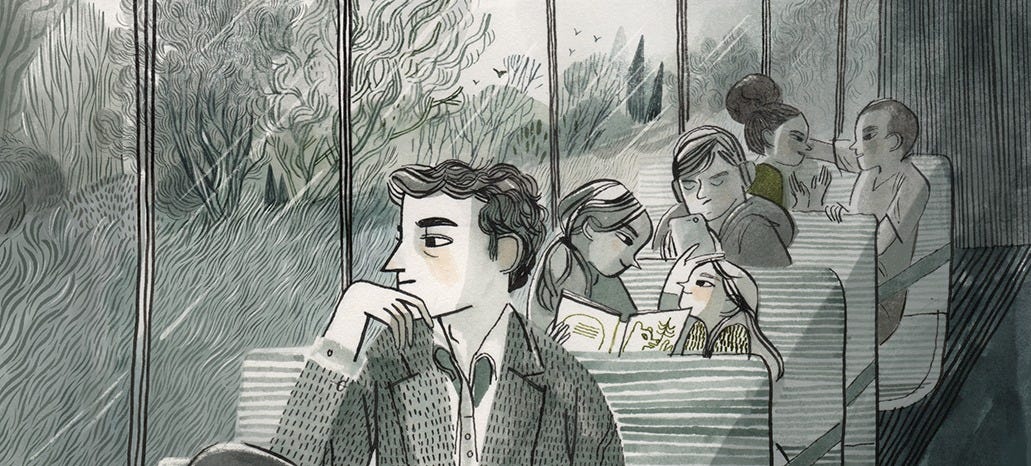
As the sun rises over rain pours down on a neighborhood in Edinburgh, a young man looks out the window, contemplating how to make something of himself. He knows. He’s going to be a doctor.
The years go by and the bright man sails through medical school with ease. Once he graduates though, he has trouble finding patients and rent proves difficult to cover. Desperate to find a niche, he packs his bags for Vienna to study ophthalmology and become an eye surgeon. But when he arrives at the prestigious medical center and sits down in the lecture hall, he finds the classes are taught entirely in German, a language he barely speaks. Distracted by his young bride and the social pleasures of the city, he profits little and eventually calls it quits.
Next, he travels to Berlin to study under a specialist, hoping to learn how to cure tuberculosis. That fails too. Defeated, he moves to England and opens a small practice. He sits in his office, and as weeks bleed into months, the phone never rings and no patient ever walks in. He’s a completely broke, entirely failed doctor.
One winter he falls gravely ill with influenza. Lying in bed, too weak to rise, he decides he is done with medicine once and for all. To pass the time and keep from sinking into total despair, our friend pulls out a scrap of paper and begins to write a fictional story about a detective who solves mysteries using logic, science, and forensic medicine. All the things the young doctor had learned in school but never got to use on real people.
The scrap of paper becomes several scraps and eventually a journal. Day in and day out, he scribbles stories into that journal. And then one day, by and by, a magazine shows interest in his stories. Fast forward a few years, and our doctor is still unemployed. But his stories about that fictional detective have been picked up by other publications and become a global phenomenon.
And wherever readers stop him to ask for an autograph, he signs their books and magazines with the name they’ve grown used to reading at the start of every Sherlock Holmes story . . . Arthur Conan Doyle.
Letting our minds wander
Summers for me as a school boy were as fulfilling or as monotonous as I made them. I remember one day when I was 14, messing with the radio out of sheer boredom and landing on a station called the Armed Forces Network. A broadcast of curated American shows meant for sailors stationed on the island where I grew up, but which made it all the way to my town seven miles to the west.
The segment I genuinely enjoyed came on right before the evening news. A man with a deep voice would read a story, structured like the opener in this issue, where a well-known person’s identity was concealed as their origin tale unfolded. Every story ended with the same catchphrase.
And now you know . . . the rest of the story.
The stories I liked most were about people who grew up believing they were destined to be in some particular line of work, but then a distraction or two, maybe a run-in with someone, maybe a revery on a train, completely changed the trajectory of their lives and caused them to be remembered by what they ended up doing.
To name just a few (these weren’t stories from that show though they might have been):
Haruki Murakami. Ran a jazz coffeehouse and bar in Tokyo for years. The idea to write a novel reportedly came to him while watching a baseball game.
Akira Kurosawa. Trained as a painter and wanted to be a visual artist. Only got into filmmaking after answering a newspaper ad for an assistant director almost on a whim.
Gabriel García Márquez. Studied law to please his parents, dropped out, worked as a journalist, and only turned fully to fiction during a drive with his family to Acapulco.
J.R.R. Tolkien. Was primarily a professor and academic linguist. Middle Earth grew out of invented languages he made for fun.
It feels like creativity can be born out of situations where we’re twiddling our thumbs, or looking out the window at passers-by, or doing something for no other reason than the joy of doing it. I was curious what the data had to say.
What does the data say?
Two experiments tested whether induced boredom helps people come up with a wider range of original ideas.
In one study,1 researchers recruited 80 people and split them into two groups of 40. One group spent 15 minutes copying numbers out of a phone book, a deliberately mind-numbing task, then rated how bored they’d felt and whether their minds had wandered. Only people who confirmed both were kept in the study. They were then given three minutes to list as many uses as they could think of for two polystyrene cups, and independent raters scored their best answers for creativity. The boredom group came up with significantly more answers than a control group given no prior task (11 vs. 7), but their best answers weren’t rated as more creative. So boredom boosted volume, not quality.
A second study2 tested whether the type of boredom mattered. 90 participants were split into three groups: control, boring-writing (the same phone-book task), and boring-reading (reading phone numbers instead of writing them down). All three groups then completed a few rounds of creative tasks, including one with no right or wrong answer and one with a single correct answer. Across these tasks, the reading group consistently outperformed both the writing group and the control, especially on the task with a definite right answer. This time, both boredom groups also produced ideas rated as more creative. So boredom boosted creativity, especially certain types of boredom.
In both studies, the authors interpreted daydreaming as the likely mediating mechanism between boredom and creativity, reasoning that writing occupies just enough attention to suppress the mind-wandering that reading allows, and it’s that mind-wandering, not boredom itself, that seems to drive the creative boost.
The benefit of daydreaming … is that seemingly illogical ideas can be explored in ways that may not be practically feasible and through this exploration a new or more suitable solution to problems or unresolved situations may be found.3
A separate study4 offers more direct evidence for that mechanism. Participants tried to solve a batch of creative problems, then took a break, either doing 1. something mentally demanding, 2. something undemanding, 3. resting, or 4. skipping the break entirely, before trying the same problems again alongside some new ones.
Only the people who did the undemanding task solved more of the problems they’d already struggled with earlier, not the new ones. And the more their minds wandered during the break, the better they did. Consciously continuing to think about the problem during the break didn’t help. The improvement seems to come from unconscious processing during the wandering itself, not from quietly working the problem in the background.
There’s a plausible brain mechanism behind this too: a network of regions that quiets down during focused, externally-directed tasks and reactivates during idle states like daydreaming, giving the brain room to make the kind of unexpected connections that look, from the outside, like inspiration.5
The long and short of it
Contrary to some of the advice out there, stepping away into something boring but undemanding (a walk, folding laundry, a long shower) may do more for our thinking than grinding through another hour of focused effort.
The key is in the word undemanding since not all breaks are equal. Scrolling social media, replying to emails, or watching something attention-grabbing keeps our mind occupied in a different direction, but it doesn’t give it room to wander. The studies above suggest the benefit comes specifically from low-stimulation activities that free our attention without fully capturing it.
This also reframes what boredom is for. Not as a problem to eliminate or fix, but potentially as an incubator for original thinking.6 A good thing to keep in mind for parents whose kids are just starting summer.
Dapper stats for your Substack
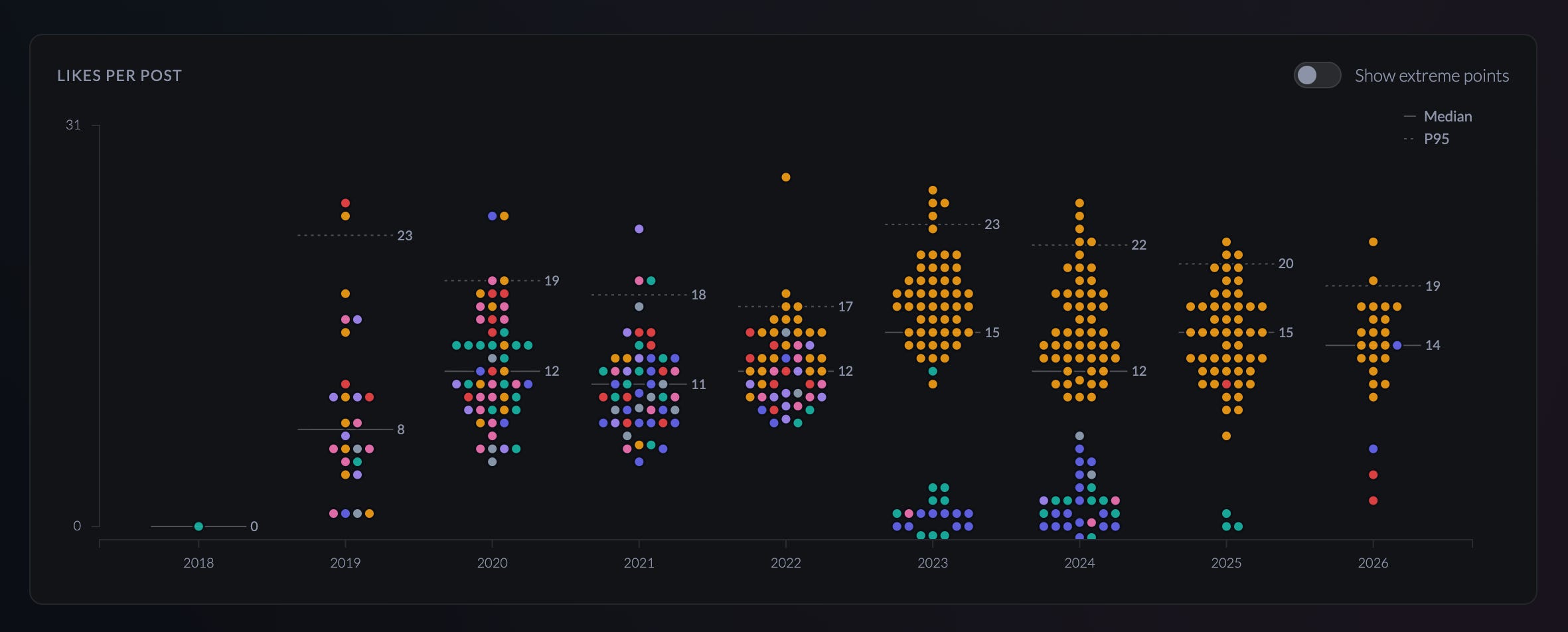
Last weekend for fun, I put together an app that pulls public metadata for a given Substack, classifies its posts into themes, and creates time-series visualizations of them. You can run it on your own Substack for free to see what your data looks like. You can see the stats for The Critical Thinker as of a couple of weeks ago.
I ran it on a few other Substacks I enjoy. Here’s one for Eric Topol’s Ground Truths. If you do run it on yours, post the link in the comments and I’ll reshare it.
We always may be what we might have been.
—Adelaide Anne Procter (The Ghost in the Picture Room)
Until next time.
Be well,
Ali
P.S. Some past issues to read through in case you missed them.


Mann, S., & Cadman, R. (2014). Does Being Bored Make Us More Creative? Creativity Research Journal, 26(2), 165–173. https://www.tandfonline.com/doi/full/10.1080/10400419.2014.901073 (read at https://fermatslibrary.com/s/does-being-bored-make-us-more-creative)
Ibid.
Ibid.
Baird, B., Smallwood, J., Mrazek, M. D., Kam, J. W. Y., Franklin, M. S., & Schooler, J. W. (2012). Inspired by Distraction: Mind Wandering Facilitates Creative Incubation. Psychological Science, 23(10), 1117–1122. https://www.cmhp.ucsb.edu/sites/default/files/2018-12/Baird%20et%20al.%20%282012%29%20Inspired%20by%20distraction.pdf
Raichle, M. E. (2015). The Brain's Default Mode Network. Annual Review of Neuroscience, 38, 433–447. https://www.annualreviews.org/content/journals/10.1146/annurev-neuro-071013-014030
One caveat worth keeping in mind is that the effects in the referenced studies show up in short, simple lab tasks, and not in complex, real-world creative or analytical work. The mechanism is plausible, but treat it as a useful nudge, not a guarantee that a walk will solve your hardest problems.
"The rest of the story" was Paul Harvey.
Here's the link to the analysis of my Substack:
https://almossawi.com/substack-dapper-stats/?utm_source=substack&utm_medium=email
Very much insightful!