

Issue No. 61
Do you ever notice people’s teeth when you’re watching something on screen or looking at a picture in print? Teeth. It’s remarkable how they can be a low-cost means to get us feeling a certain way about a person, all without a word of dialogue being spoken.
What we perceive as good teeth and bad teeth and the meanings behind them can feed into two cognitive effects. The halo effect, where we assume someone who has one good feature (a feature we deem good) must have other good features as well. And conversely, the horn effect, where we assume someone with one bad feature must be bad in other ways too. Of course, a tooth isn’t inherently bad or good until we decide it’s one or the other, and portrayals through images are oftentimes what help us decide.
In the TV show Man on the Inside starring Ted Danson, a widowed and retired engineering professor from Oakland finds his calling as a private investigator. One day, as he’s looking into a corruption case on a college campus, he runs into a crowd protesting the wealthy donor they believe wants to destroy their school. Some students carry a banner with the guy’s face on it, and it becomes apparent that several of his front teeth are missing. It’s in a cut we only see for a few seconds, but it was long enough to really intrigue me because it brought back a rush of visuals I’d seen over the years about people whose teeth told me, in a sense, how I ought to feel about them.
Teeth that lower a person
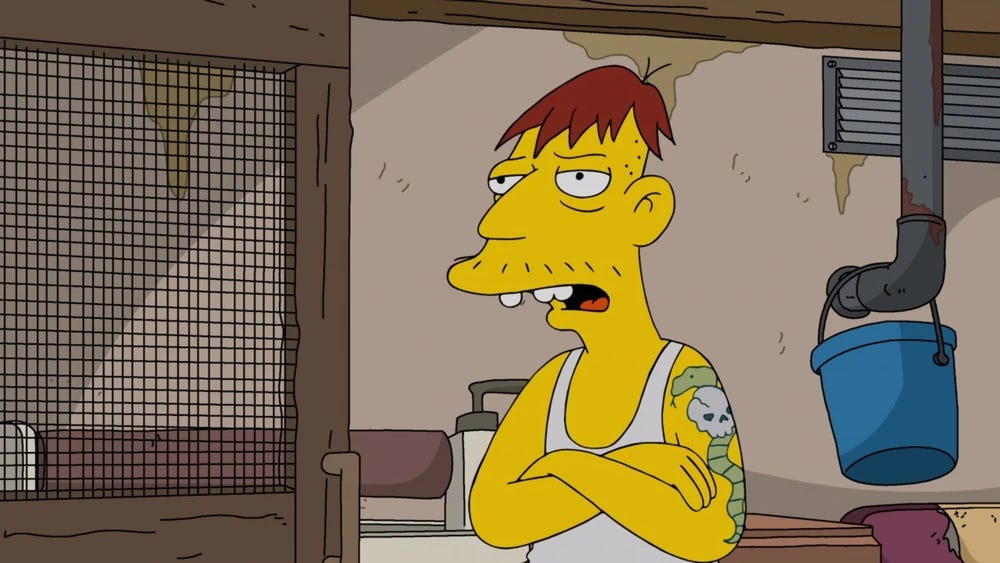
In The Simpsons, Cletus Spuckler represents a Southern rural character. He walks around in a tank top and jeans, and is a father to 17 children, or 29, or 72, depending on the episode. He has missing teeth, as does his wife, and it’s insinuated at one point that she might in fact be a relative. The running joke is that Cletus is uneducated and simple-minded.
In the TV show Orange Is the New Black, the antagonist Pennsatucky is an inmate who similarly comes from a rural background and has a history of drug abuse. An open mouth reveals all of three half-broken teeth poking out of her top gum, with the others blackened and badly deformed. In my first viewing of the show, I attributed her appearance solely to her being an addict. Then I learned bad teeth happen because of poverty too. Bad coverage and bad nutrition lead to bad teeth, and bad teeth cost people work and standing, which keeps them where they were. That cycle then feeds the portrayal of “rural” characters on screen.1
In the miniseries Griselda about a notorious drug lord, actress Sofía Vergara has to be transformed into a “plain, average kind of person in the 1970s.” Makeup artists go to work on her eyebrows and nose, but there’s still something wrong with her. A makeup artist explains, “Once Vergara started reciting her lines … her ‘glorious white teeth’ offered a jarring contrast to the plain look they had given the rest of her face. So, a set of fake teeth was made by Art Sakamoto.”2
Yellow prosthetic teeth were a choice in order to make the character look plainer even though the original Griselda Blanco, according to her family, never looked plain in her youth. But in order to make the character believable as an everyday person to audiences, white teeth had to be replaced with dirty-looking dentures.
Teeth that evoke ridicule
In the Austin Powers film series, the protagonist’s teeth are a punchline, meant as a play on a stereotype of Brits and bad oral hygiene. Similarly, in an episode of The Simpsons, a dentist has The Big Book of British Smiles on hand, which he whips out to scare Ralph—and presumably other kids too—into flossing. What’s interesting about this use is that teeth work as a mechanism for ridicule when it involves a group we the audience don’t fear. Brits, bad teeth, chuckle chuckle, is the expected feed line and punch line with this sort of gag. It comes across differently if it’s, say, a character or a group that’s an unknown quantity to us.
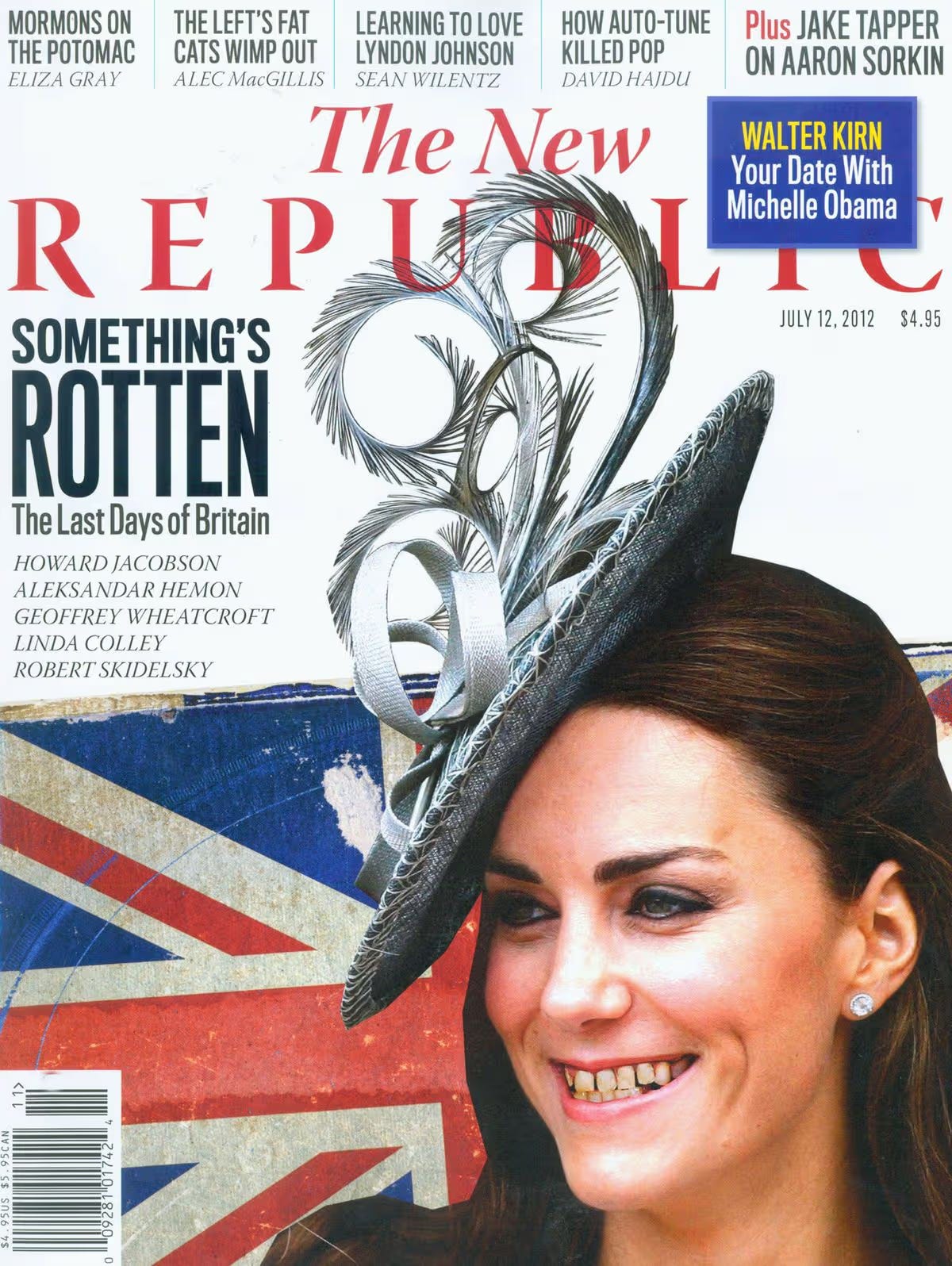
We find teeth in print as well. On the cover of the July 12, 2012 issue of The New Republic, Kate Middleton is pictured with yellow, badly spaced teeth and inflamed gums. The caption reads, “Something’s Rotten: The Last Days of Britain.”3 The magazine had its pick of anyone for that cover gag and chose to go for the person with the most recognizable smile.
Teeth that evoke menace
In A Hologram for The King, Tom Hanks’ character is walking in the desert kicking rocks and taking pictures when a car pulls up to him. The driver rolls down his window and smiles revealing two massive, hideously stained front teeth. You know right away he’s up to no good. And he isn’t.4
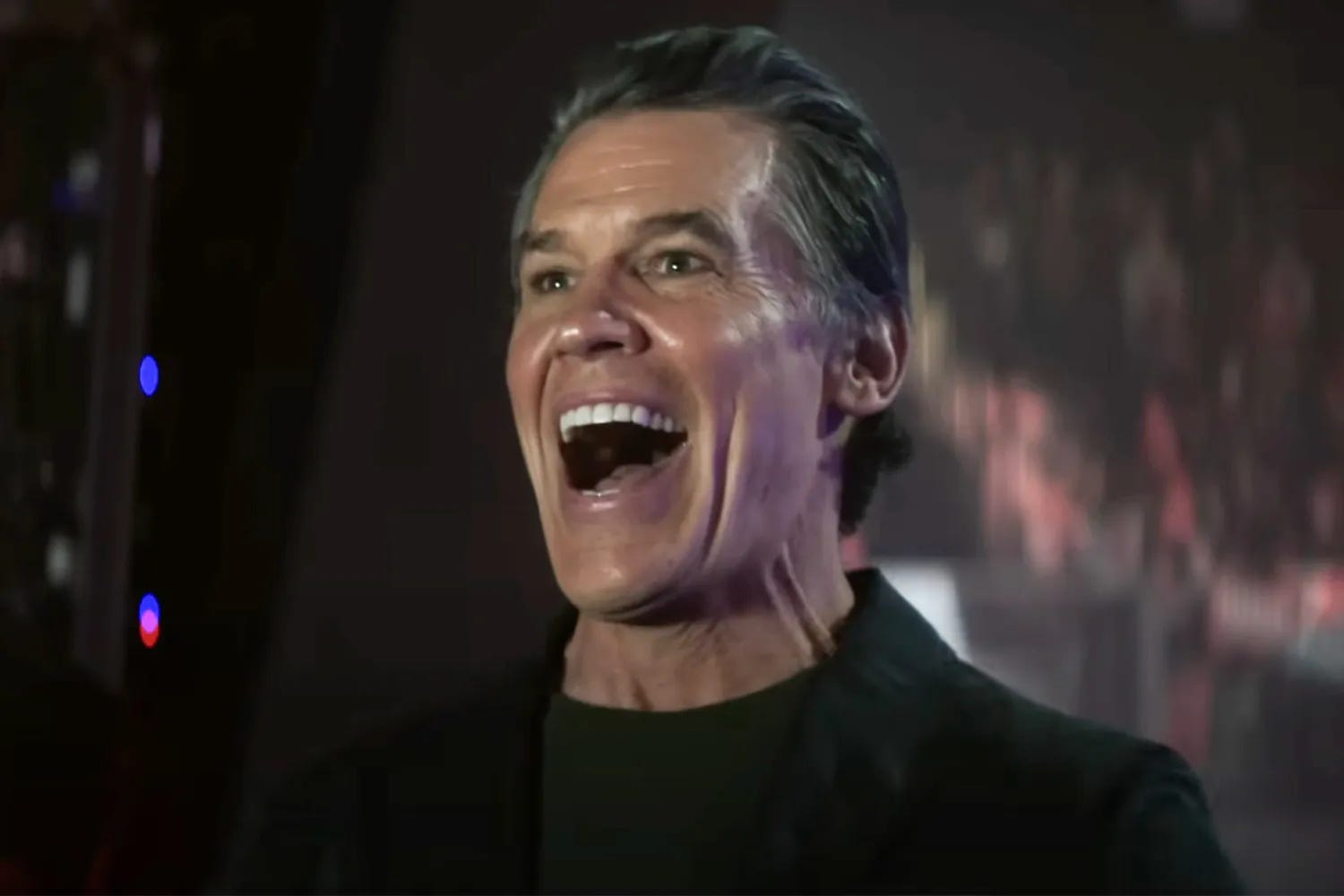
In The Running Man, we have a character who is a cold-blooded executive producer. The actor in this case, Josh Brolin, wears veneers to make his teeth appear blindingly white precisely so that he comes across as sinister. Brolin shares in an interview, “Dentists have always wanted to whiten my teeth, and I go, No, it would ruin my career if you whiten my teeth. I’ve built my career on yellow teeth.”5 Brolin plays Thanos in the Marvel Cinematic Universe, where something other than his teeth also contribute to his appearance (can’t quite put my finger on it) and antagonists in various other roles. In this case, bright, white teeth were used to signal something menacing.
In The Return of the King, Sméagol’s transformation into Gollum involves his teeth going from a relatively nice set to pointy, spaced-out, predatory teeth.6 “Teeth! teeth! my preciousss; but we has only six!” he says in The Hobbit; in the film version of that scene, An Unexpected Journey, the number becomes nine. The Joker, especially in print, is all teeth. You can’t picture him in fact without seeing his grin and two rows of massive teeth.
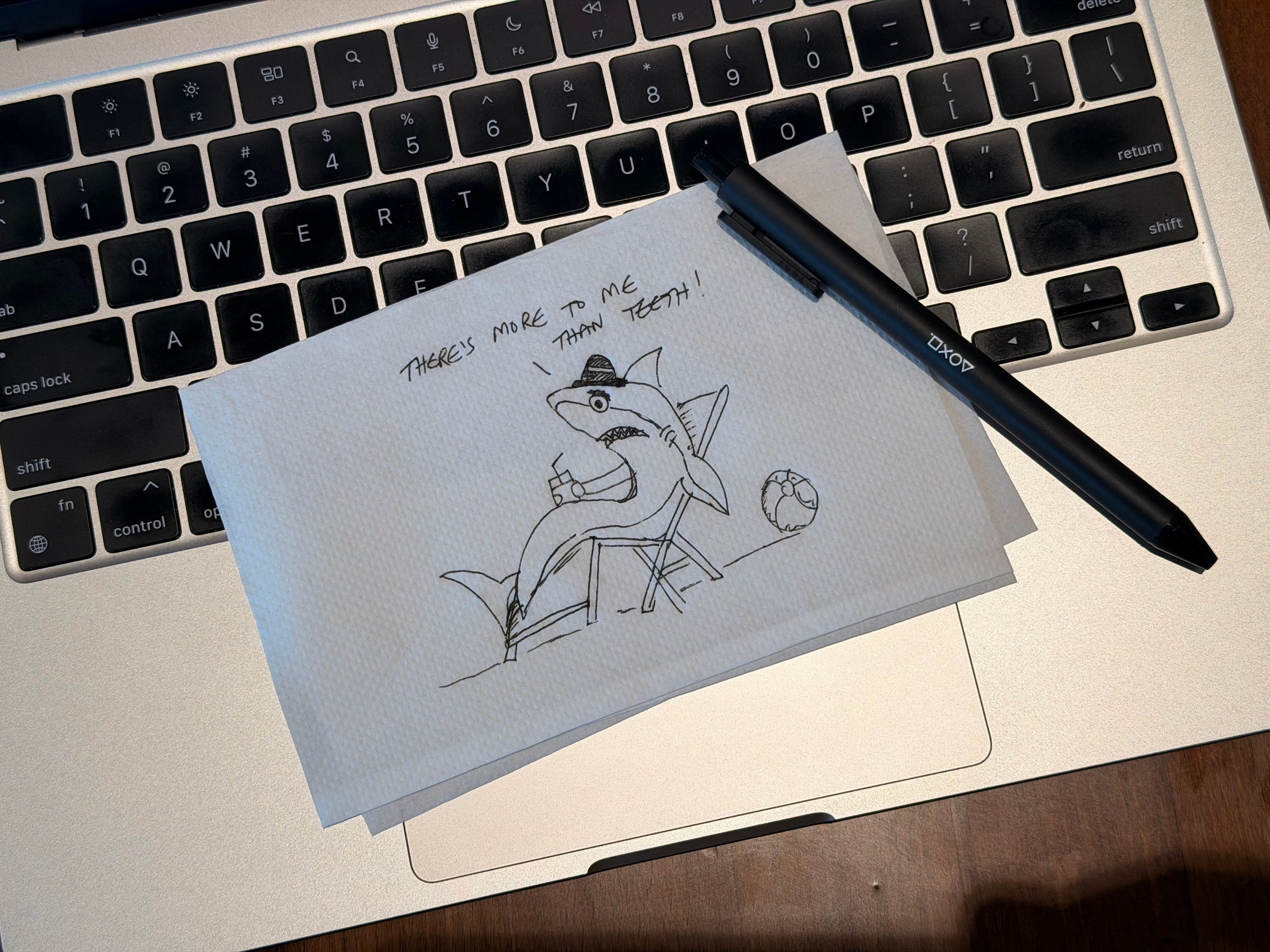
The same goes for the great white shark in Jaws who is all teeth. No amount of personality will make up for that poor shark’s central feature—his massive teeth. He might have been a really good listener, but we never get to learn that about him.
The portrayal of DC’s Penguin has changed over the years on screen, but teeth pop up as a physical cue twice and to different ends. In the 1960s, the Penguin is flamboyant and wears a top hat. In the 1992 Danny DeVito portrayal, he has sharp teeth and a body shaped like an egg. Then in the 2022 Colin Farrell portrayal, he has gold-capped teeth and a scarred face. Here, he’s portrayed not as inherently deformed, but shaped by a hard life of crime.
In older Disney animations, we find plenty of up-to-no-good characters in need of orthodontic interventions. In The Little Mermaid, Ursula has a significant underbite, as does Captain Hook in Peter Pan. In Aladdin, Jafar has a noticeably large lower jaw and individually drawn teeth and some palace guards have missing teeth. Judge Frollo in The Hunchback of Notre Dame has a bad edge-to-edge bite, Chi-Fu in Mulan is missing most of his front teeth, Hades in Hercules has the pointiest teeth. They’re all overt, and some are squarely on-the-nose.
Disney has largely stopped drawing villains with such overt cues, which is why villains in more recent films like Frozen and Zootopia appear benign at first and only later do they reveal themselves. The reason this twist works is likely because we the viewers have internalized the mapping of cues to qualities, so a handsome-looking character with “normal” teeth is perceived as an ally until the twist reveals them for who they really are.
Everything so far has been about teeth that belong to a character. They were born that way, or life made them that way, we’re made to understand. Sometimes, though, someone puts teeth on to be someone else, and wants you to know it.
There was a TikTok trend that went viral a few years ago, in which young people from one community dressed up as people from another, their faces painted in performances of racial mimicry, lip-syncing to a song about ruined homes. What constituted the mimicry? Facial moles in some videos, unibrows in others, heads covered in bin bags in most. But in the overwhelming majority of those videos, the physical cue of choice was blacked-out teeth. In the fifteen videos I surveyed, nine of them included it.
Takeaway
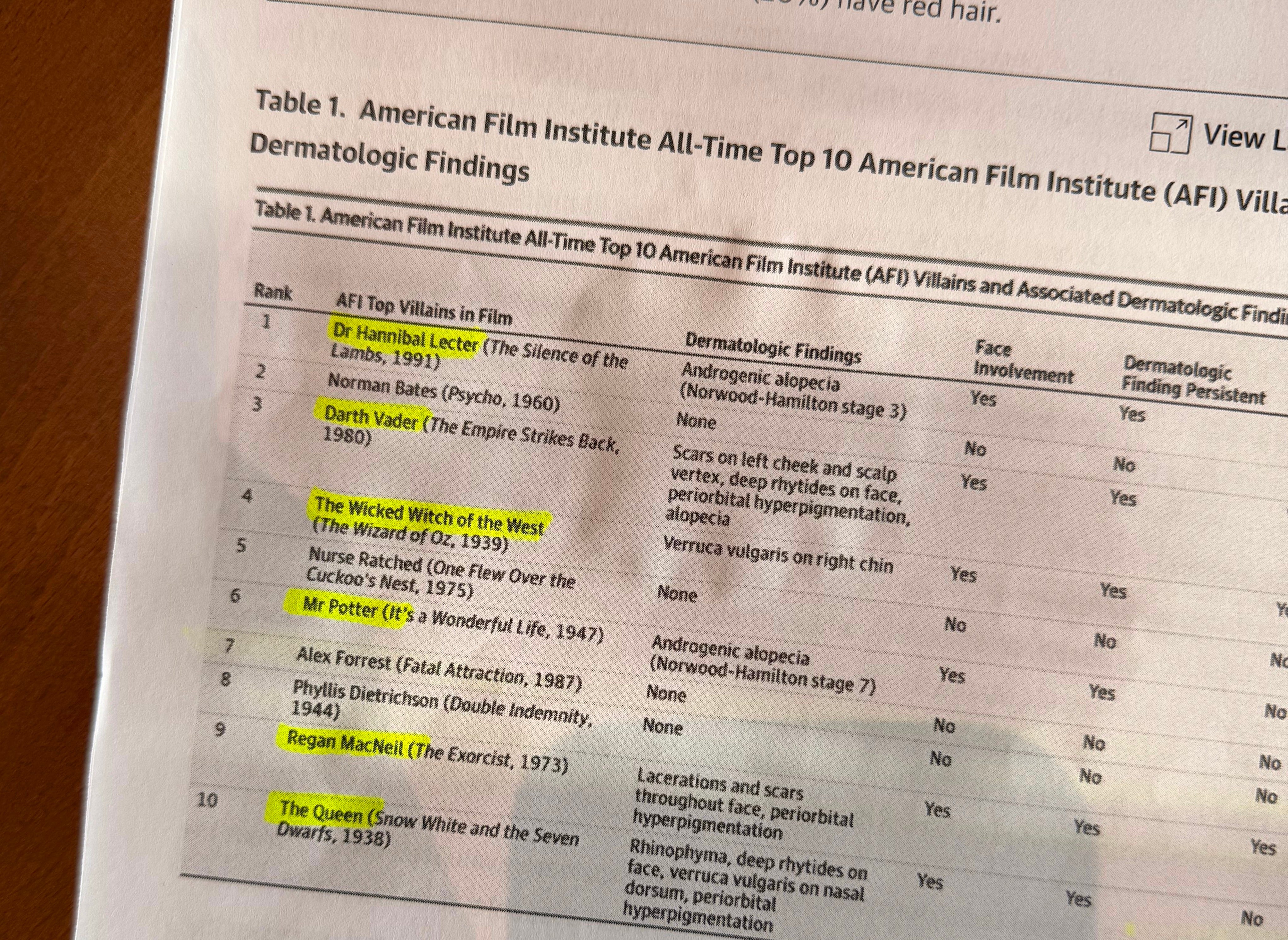
What the examples we’ve seen in this issue show us is the ease with which a seemingly banal part of the body can be used to maneuver us into feeling a certain way about a person or a group. It’s not always to a nefarious end. But the fact that it’s so cheap, and so effective is worth pondering. If teeth can do that, imagine all the other cues that are on offer and are capable of doing the same thing. Six of the top ten American Film Institute villains of all time, for instance, suffer from … can you guess? They suffer from dermatological conditions. Conversely, none of the top ten heroes do. Isn’t that interesting?7
All cruelty springs from weakness.
—Seneca (On the Happy Life)
Until next time.
Be well,
Ali
P.S. Some past issues to read through in case you missed them.


According to a 2009 study for instance, 936,000 ER visits were teeth-related, https://aeon.co/essays/there-is-no-shame-worse-than-poor-teeth-in-a-rich-world
https://www.hollywoodreporter.com/tv/tv-features/griselda-sofia-vergara-columbia-queenpin-1235921514
https://www.mirror.co.uk/news/uk-news/duchess-of-cambridge-kate-middleton-flashes-1135202
https://youtube.com/watch?v=b-Mfe75KnbA
https://www.aol.com/articles/josh-brolin-went-glenn-closes-130000415.html
Tolkien calls them fangs in The Hobbit, “He thought of all the things he kept in his own pockets: fish-bones, goblins’ teeth, wet shells, a bit of bat-wing, a sharp stone to sharpen his fangs on, and other nasty things. He tried to think what other people kept in their pockets.”
https://pubmed.ncbi.nlm.nih.gov/28384669
As a woman, meeting a man who has bad teeth, in any sense, is red flag. It's a sign of past traumas she may or may not be willing to deal with.
Conversely, a good set of teeth on a man shows that he knows how to take care of himself. It shows a senstivity for hygeine and wellness. And if he knows that for himself, then it will be more than likely that he will be sensitive for those things for his potential partner.
And if a woman can see all that in a flash of pearlies, then she can have a bit more confidence in that bright smile rather than the man who does not.